
Ethiopian Opal Price Per Carat Guide: Why Same-Size Opals Have Different Value

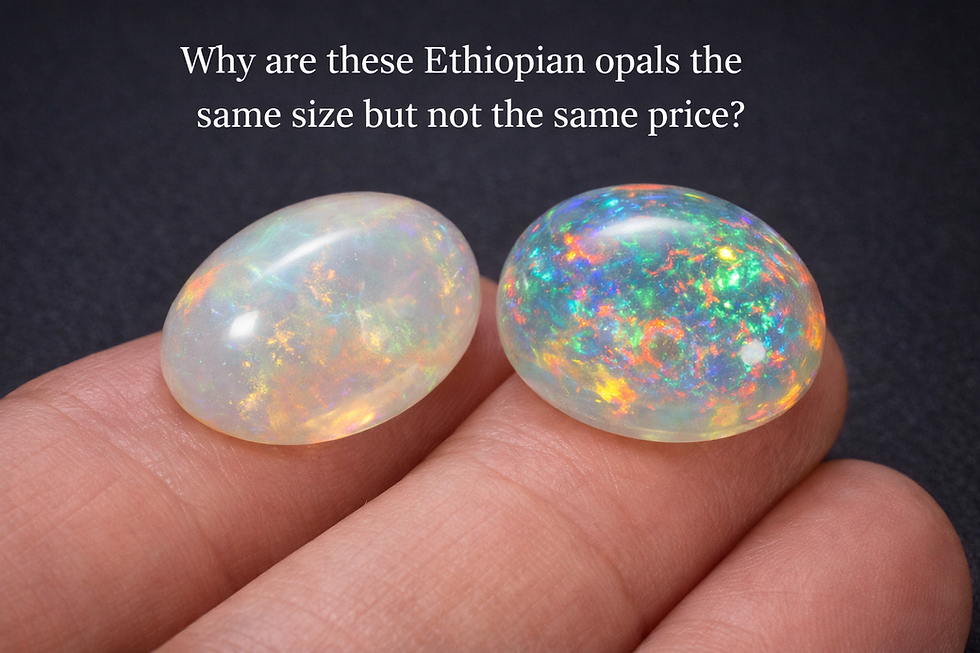
A few months ago, a jeweler from Germany sat across my desk in Jaipur, studying two Ethiopian opals I had placed in front of him.
Both were almost identical in size.
Both weighed just over 6 carats.
He picked up the first stone, turned it under the light, and nodded.
Then he picked up the second one—and paused.
He looked at me and said,
“I don’t understand. This one is five times more expensive. What am I missing?”
This is the moment when most buyers realize something important.
With Ethiopian opals, size tells you almost nothing about value.
I’ve seen 4-carat stones sell for more than 10-carat stones.
Not because of origin.
Not because of treatment.
But because of quality.
Once you understand what controls the Ethiopian opal price per carat, the price differences stop looking random—and start making perfect sense.
Ethiopian Opal Pricing Doesn’t Work Like Most Gemstones
Most buyers assume gemstones follow a simple rule:
Bigger stone = higher price.
That logic works for some gems.
It doesn’t work for Ethiopian opal.
Two stones from the same mine in Ethiopia can have completely different value—even when their weight is identical.
The reason is simple.
Ethiopian opal is valued based on visual performance, not just size.
What matters is what happens inside the stone.
This is especially true for crystal Ethiopian opal, where light performance determines desirability far more than carat weight alone.
Fire Is What Buyers Are Really Paying For

When someone pays a high price for Ethiopian opal, they are not paying for carat weight.
They are paying for fire.
Fire is what gives the stone life.
Not all fire is equal.
Some stones show faint color only at certain angles.
Others explode with color the moment light hits them.
I still remember opening a parcel years ago and seeing one crystal opal that flashed electric blue across its entire surface. Even before weighing it, I knew it was special.
That stone sold within two days.
Not because it was large.
Because it was alive.
That’s the difference buyers feel immediately—even if they can’t explain it technically.
This is one of the biggest reasons Ethiopian Welo opal prices varies so widely in the market.
Transparency Changes Everything
This is something experienced buyers notice instantly.
Crystal Ethiopian opals allow light to travel deeper into the stone.
This makes the fire appear sharper and brighter.
Milky stones, on the other hand, soften that effect.
They can still be beautiful—but they rarely command the same price per carat.
When you place a crystal opal and a milky opal side by side, the difference becomes obvious.
One feels open and bright.
The other feels closed.
Collectors almost always choose the crystal stone.
Brightness Is Where Real Value Separates
Two opals may show the same colors.
But brightness is what separates average stones from valuable ones.
Brightness is not about how many colors are present.
It’s about how strongly they appear.
A bright Ethiopian opal doesn’t need to be examined closely.
It announces itself.
Even in a parcel of hundreds of stones, your eye goes straight to it.
Those are the stones that sell first.
And those are the stones that command a higher Ethiopian opal price per carat.
This is also where opal brightness grading becomes important for serious buyers and collectors.
Cut Is Often the Hidden Factor Buyers Overlook
Cutting Ethiopian opal is not just about shaping the stone.
It’s about revealing its best side
A cutter decides:
How high the dome should be
Where the brightest fire sits
How the light will reflect
I’ve seen stones that looked average in rough form become exceptional after proper cutting.
And I’ve seen good rough lose value because of poor cutting.
When buyers compare two same-size opals, the difference they see is often the result of cutting decisions made months earlier.
Here’s a Real Comparison From Our Inventory
Both stones came from the same parcel.
Both weighed around 5.5 carats.
The first stone showed soft blue fire in limited areas.
It was pleasant.
But quiet.
It sold for $70 per carat.
The second stone had sharp, bright fire visible across the entire surface.
Every movement revealed something new.
It sold for $340 per carat.
Same origin.
Same size.
Completely different value.
And the buyer who chose the second stone never asked about the price again.
Because once you see the difference, you understand it.
This Is Why Experienced Buyers Never Ask Size First
New buyers ask:
“How many carats is it?”
Experienced buyers ask:
“How good is it?”
They know size alone doesn’t determine desirability.
Beauty does.
A smaller stone with strong fire will always be easier to sell, easier to set in jewelry, and easier to appreciate over time.
Large stones with weak performance often sit unsold.
This is something the market proves again and again.
This reality explains why opals vary in price, even when measurements look identical on paper.
Ethiopian Opal Price Per Carat Reflects Rarity, Not Weight
High-quality Ethiopian opals are not common.
Most rough produces commercial-grade stones.
Only a small percentage produces fine crystal material with strong brightness.
That rarity is what buyers are paying for.
Not the grams.
Not the millimeters.
The rarity.
Quick Buyer Test Under Light (Practical Checklist)
Before buying, use this simple test:
Does color appear instantly or only at certain angles?
Is the body transparent or milky?
Does brightness remain strong across the surface?
Does the stone stay lively as you move it?
These quick observations reveal more about value than carat weight alone.
This is why serious buyers evaluate light before they evaluate weight.
What Smart Buyers Look for Before Purchasing
They move the stone under light.
They check how quickly the fire responds.
They observe transparency.
They notice brightness.
They trust their eyes—not just the scale.
Because the scale doesn’t show beauty.
Light does.
The Truth Most Sellers Don’t Explain Clearly
When two Ethiopian opals have the same carat weight but different prices, it’s not arbitrary.
It’s visual performance.
It’s how the stone interacts with light.
It’s how rare that performance is.
And it’s how strongly people react when they see it.
That reaction is what creates value.
Final Thought From Someone Who Handles These Stones Every Day
After working with Ethiopian opals for years, one pattern never changes.
The best stones don’t need explanation.
Buyers recognize them instantly.
They don’t ask why they cost more.
They ask if they’re still available.
That is what truly defines Ethiopian opal price per carat.
Not size.
But presence.
And this is why serious buyers evaluate light before they evaluate weight.

Comments